News
3 September 2025
Enabel actively involved in second African climate summit in Ethiopia
Interview
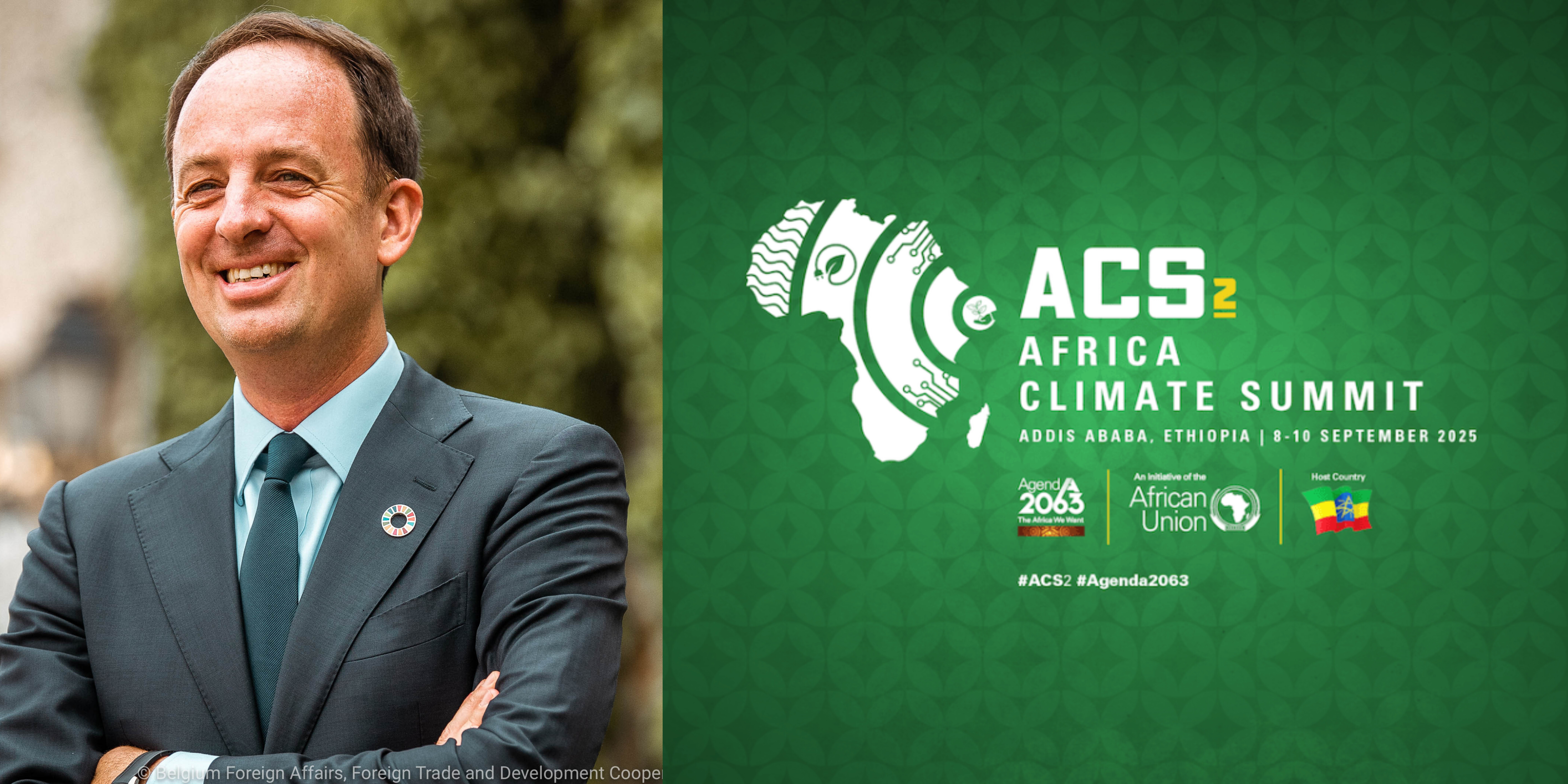
The second African Climate Summit (ACS), taking place from 8 to 10 September in Addis Ababa, Ethiopia, will bring together more than 45 African heads of state, 100 speakers and 25,000 delegates, including regional leaders, youth, representatives of civil society, the private sector, philanthropic organisations and stakeholders. The aim is to formulate a joint African position on the global climate agenda.
A preview with Jean Van Wetter, CEO of Enabel
Why is this African climate summit important?
Jean Van Wetter : Climate change has faded into the background a bit due to the terrible conflicts that have dominated current affairs over the past 2-3 years, particularly in Gaza and Ukraine. But climate remains the challenge of the century. Africa, hit hard by climate change, will exceed 4 billion people by the year 2100. So energy transition and renewable energy development is a primordial challenge not only for Africa, but for the planet. This climate summit is an initiative of the African Union, seeking to underline its leadership to effectively tackle climate change. The AU also realises that climate change is not only a global challenge but also an economic opportunity.
What will Enabel do there?
Jean Van Wetter : We have no choice but to support this initiative because climate does not stop at borders and we have every interest in working together. Enabel was asked by the Ethiopian government to help prepare for this climate summit, based on our experience in Mozambique where we are working with the government to find financial solutions for energy transition and a climate-resilient economy. Energy transition is accompanied by the emergence of new economic sectors, such as electric mobility, bioenergy, green hydrogen, batteries, green cooking technologies and alternative fuels. These sectors offer real opportunities to create local jobs. The number of startups and local companies operating in the renewable energy sector continues to grow in Africa, reflecting strong entrepreneurial dynamics. However, these initiatives continue to face a significant need for funding to scale up and sustain their impact. We are also advising local partners in the Sahel, Senegal, Burkina Faso, Mali and Niger to cope with climate change. And in Côte d’Ivoire, Enabel is working with the government to ensure that no forests are cut down when growing cocoa and coffee, as required by EU rules. This climate summit gives us the opportunity to share our experience with experts and decision-makers in the global discussions on climate and energy transition. It is a lever that allows us to offer our expertise for sustainable partnerships with Africa, and to contribute to broader policy dialogues, particularly in the areas of innovative financing, private sector engagement and reform of the international financial architecture.
We are also attending the ACS in our capacity as co-chair of the Practitioners’ Network, which brings together 25 European agencies. No one can tackle climate change alone, which is why we are also trying to set up more joint projects through that network. The energy transition offers great opportunities to work more together, to pool our strengths and resources, also with the business world. I am thinking for instance of Mission 300, a World Bank and African Development Bank initiative to provide electricity to 300 million Africans in the next 5 years. Such pan-African initiatives show that cooperation between countries is not only useful, but necessary to tackle cross-border problems. More international cooperation is needed, not less.
“Climate remains the challenge of the century. Africa, hit hard by climate change, will exceed 4 billion people by the year 2100. So energy transition and renewable energy development is a primordial challenge not only for Africa, but for the planet. “
Following the climate summit, Enabel, together with the Swedish agency SIDA in their capacity as co-chairs of the Practitioners’ Network, is leading a fact-finding mission to Lubumbashi in the DR Congo and Ndola and Lusaka in Zambia as part of the Lobito corridor. What do you hope to find?
Jean Van Wetter : The Lobito Corridor is a large-scale infrastructure project creating a rail link between the port city of Lobito on the Atlantic coast of Angola and mineral-rich regions in the Democratic Republic of Congo and Zambia. The aim is to provide an efficient and sustainable route for the export of critical minerals such as copper and cobalt. The corridor should also boost regional trade, create jobs and contribute to the economic development of Angola, Zambia and the DRC. The project is supported in part by the EU through the Global Gateway. We are travelling with an extended delegation, with representatives from Italy, Germany, the Netherlands, Sweden, France, the Czech Republic, Finland and the EU, and we want to see how Team Europe can play a role in the development of the corridor. How we as public agencies, together with the European Commission, can get the private sector on board for this project. Because it’s not just about a railway, but also about roads, about trade routes, opening up agricultural areas. You can compare it to the way the European Union sets up infrastructure works to integrate the European market.
What is Enabel’s role in this story ?
Jean Van Wetter: Our role as a Belgian agency for international cooperation is that we can help create an investment-friendly environment, good governance, vocational training. And Team Europe must also ensure that there is no fragmentation, with too many small projects coexisting side by side, without coherence. Enabel is already present in Katanga, and SIDA is active in Zambia. It is important to align our work so that we develop the same vision for the Lobito corridor. To have real lasting impact, you need to work together, and the Practitioners’ Network is an obvious platform to do that. We are going to feed the lessons from this trip back to the EU at the Global Gateway Forum in Brussels on 9 and 10 October. We are going to propose a scenario to work better and more together through the Practitioners’ Network, the DFIs (Development Finance Institutions), through JEFIC (Joint European Financiers for International Cooperation), through the export credit agencies. I hope this visit can be an eye-opener, because again, we need to work together more than ever before.