News
10 October 2024
Coffee, books and emancipation
A blog by Esther Philippen, Junior Expert for Rikolto in Uganda.
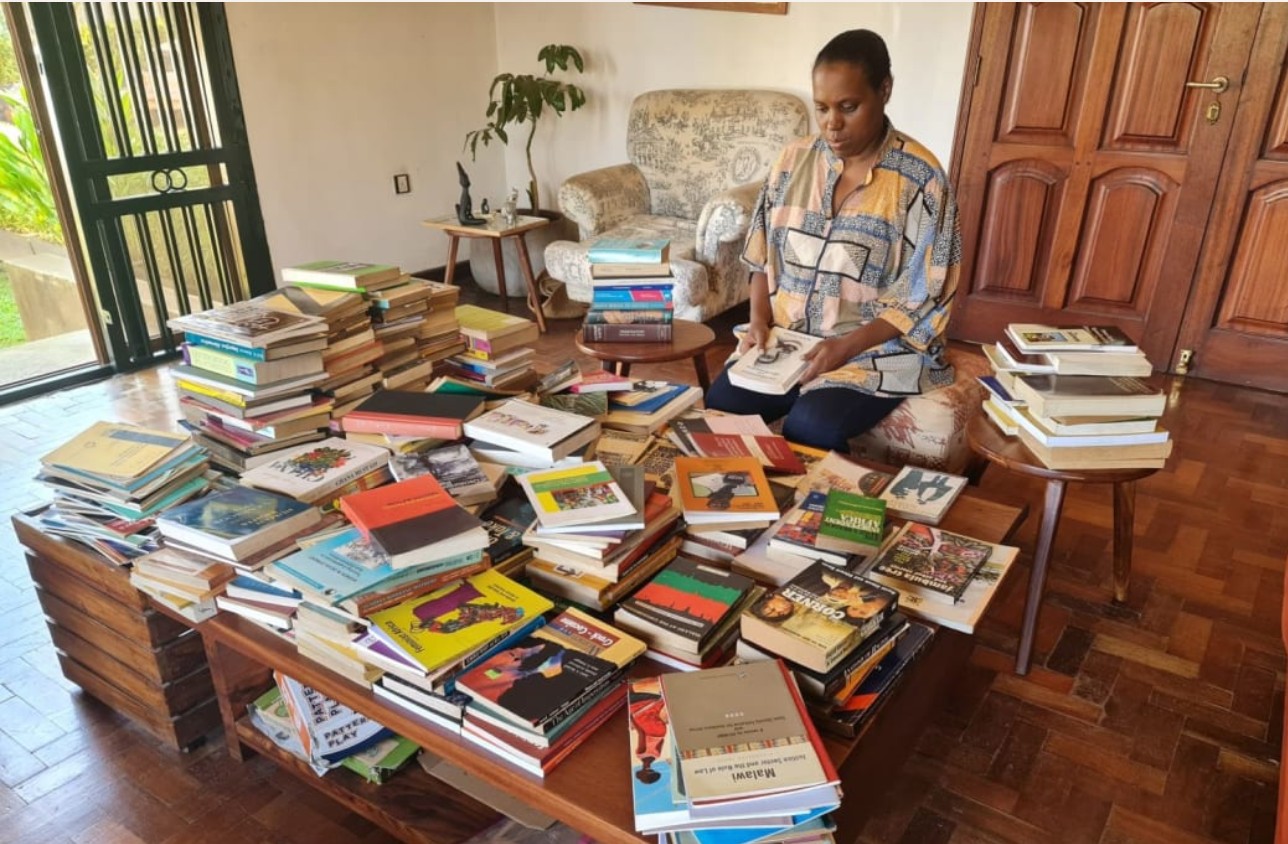
In a seemingly small, cute coffee bar in Bugolobi, in Kampala the capital of Uganda, called Sankara Pan-african Library, you will find a bookshelf that takes up an entire wall. If you take a closer look at that bookshelf, you will see a wealth of works by writers of African descent, both fiction and non-fiction.
The books all tell stories about and advocate for emancipation, decolonisation and anti-racism. However, this coffee bar is more than just a nice book café with an inspiring bookshelf to escape the hustle and bustle of Kampala; it is a whole movement.
White saviour complex
Sankara Pan-african Library is a project of “No White Saviours”, a grassroots organisation with a three-pillar structure: education, policy influencing and activism. No White Saviours’ original mission was to denounce the white saviour complex, particularly in Christian missionary organisations, NGOs and foreign aid organisations in Uganda and the African continent as a whole.
Over the years, their mission changed and Pan-Africanism and emancipation became more central. This was achieved through more actions via policy influencing, workshops on Pan-Africanism and decolonisation, and the library as a space for learning and sharing experiences.
Olivia Alaso, one of the founders of No White Saviours and the library, has worked as a social worker in Jinja (a city at the source of the Nile in Uganda) for various NGOs. Through her work, she has had negative experiences with colonial practices and the white saviour complex.
Together with other founders of No White Saviours, she began discussing the white saviour complex, and thus the No White Saviours movement was born. Olivia’s idea was to set up a library to educate people about the white saviour complex and (de)colonisation, and No White Saviours helped to build the library. This is how the Sankara Pan-African Library came into being.
The library is named after Sankara, a former Burkinabe leader, because he had a positive influence on women’s rights and female leadership in his country by stating that there can be no real social revolution without the emancipation of women. Moreover, he is a Pan-Africanist through and through. The library is also known as “Kusimama Africa” or, translated from Swahili: stand tall, Africa.
Political forum or not?
Olivia defines Pan-Africanism as “freedom for everyone to discover and feel who they are”. The headquarters of the global Pan-African movement is located in Uganda, but to date there has been no structural cooperation. According to Olivia, they see things their own way and are reluctant to change this for the time being. They see Pan-Africanism more as a business model.
For Olivia, however, the library should not be a political forum: everyone has their own affiliations, identities and points of view. If the library were to take sides, it would leave no room for discussion and constructive dialogue.
It is mainly young people who find this place very important. Young people have used this place to come together, debate and exchange experiences about decolonisation and Pan-Africanism. In addition to book clubs, the library regularly organises quiz nights, film screenings, and events with interesting and inspiring speakers.
The library also has a good relationship with Dr. Sylvia Tamale, a Ugandan academic, human rights activist and first female dean of the law faculty at Makerere University (the largest and second oldest institution of higher education in Uganda). She donated books to the library to expand its collection. The library also collaborates with Makerere and Chambo University: they support two students and interns who have difficulty paying their tuition fees but are interested in studying Pan-Africanism. Olivia’s dream is to grow the library into a Sankara school – a free school for students who want to learn about (de)colonisation and Pan-Africanism.
For more information about the library and how to support it, please contact Olivia Alaso via WhatsApp on +256 785 251967 or by email: alasoolivia@gmail.com.
Esther Philippen worked for Rikolto in Uganda last year through Enabel’s junior programme. She set up a platform with various actors from the rice sector in that country to promote sustainable rice in the region.
She lived in Kampala for a year and got to know the Sankara Pan-African Library during her stay. This book café is the gathering place for an entire movement, which evolved from denouncing the “White saviour complex” to an organisation that debates decolonisation and Pan-Africanism. Esther visited the place and wrote a blog about it, which was published on the website of Mo-Magazine.