News
4 September 2026
Hybrid by necessity: building financial resilience to scale impact
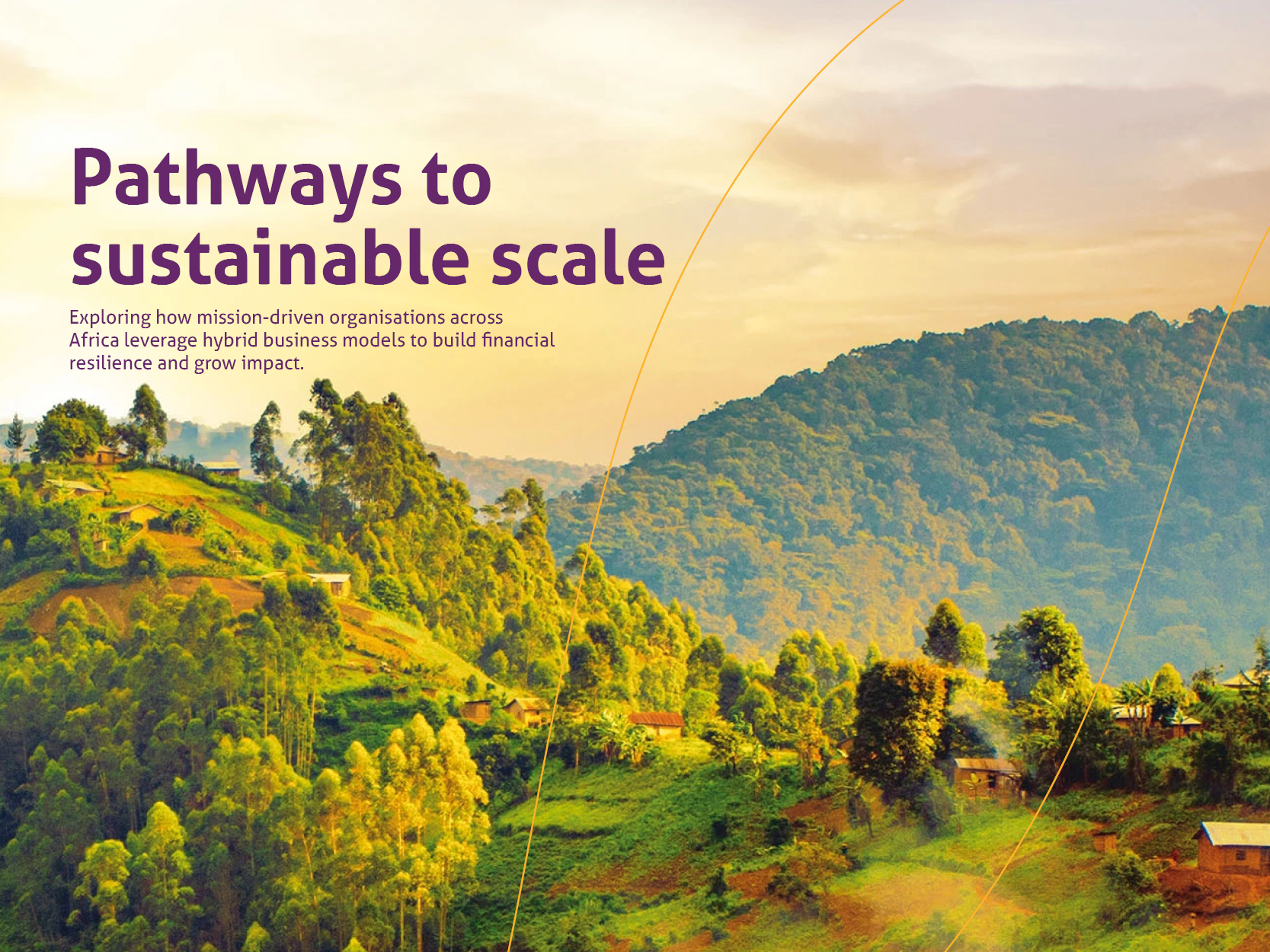
Across Africa, mission-driven organisations face a dual challenge: staying accessible to users who often cannot pay the full cost of a service, while building financial models resilient enough to survive and grow. To better understand innovators and how to support them more effectively, Enabel partnered with Brink to explore what enables organisations to scale.
The research shows that successful scaling is rarely driven by technology alone. What sets these organisations apart is their ability to continuously evolve their business models, practices and mindsets.
Funding sources are shifting, expectations around evidence and accountability are rising, and the work itself is becoming more complex. In this environment, organisations rarely follow a linear path. They move through a series of model evolutions driven by funding volatility, policy shifts, affordability pressures and operational demands. Shocks, such as losing a grant or absorbing rising costs, often trigger change more than strategy alone.
Almost all the organisations studied as part of the research are hybrid : they blend grants, earned income, philanthropic support, public contracts and commercial partnerships to stay accessible while strengthening financial resilience. Hybridity is rarely a deliberate identity. It emerges because single revenue streams prove insufficient or unreliable for the challenges these organisations set out to address.
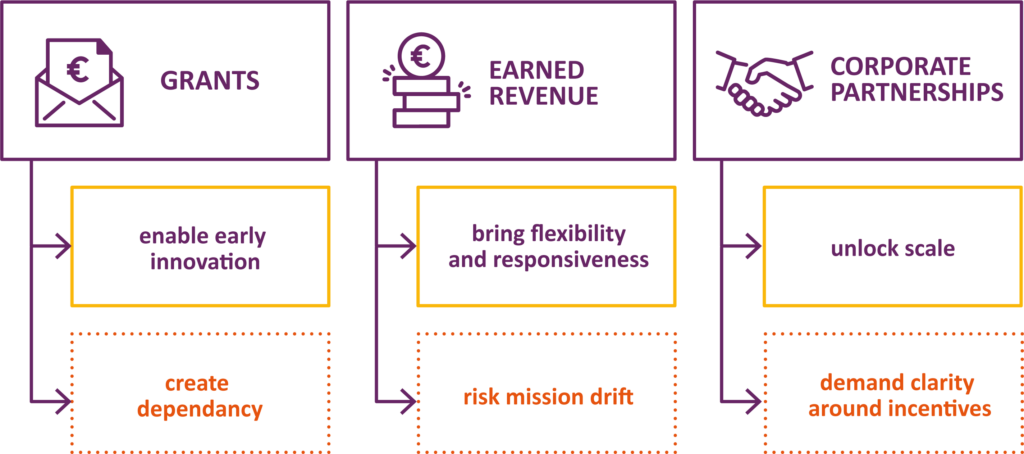
Models shift as conditions change; pragmatic decisions reflect affordability, regulation, and operational realities, and mission-anchored financial choices are made in service of purpose. Hybridity is also shaped by behaviour: grants can enable early innovation but also create dependency; earned revenue can bring flexibility and responsiveness, but also risk mission drift; and corporate partnerships can unlock scale, but demand clarity around incentives.
The findings of this research now inform Fit for Scale, Enabel’s practical approach to supporting organisations that want to build more sustainable business models suited to scaling their innovations. For Enabel, the role is that of a connector: aligning real demand, evidence and institutional pathways so that proven solutions can be adopted at system level. The full research explores each of these dynamics in depth, with concrete examples and organisational voices.
From a donor-recipient logic to a scaling mindset
The research points to a wider evolution in how organisations think about growth. Financial sustainability is no longer framed only through the lens of project funding and the relationship between a donor and a recipient. Increasingly, it is approached through a scaling logic: diversifying resources, adapting the organisation, and focusing on durable, system-level impact.
This is an evolution rather than a rupture. Grant funding remains essential, often as the capital that underwrites experimentation while earned-income pathways mature. What changes is the posture: organisations plan for the long term, share financial responsibility with communities and partners, and design for adoption rather than dependency.
The Hybrid Archetypes Model
To make sense of these journeys, the research proposes a Hybrid Archetypes Model with three profiles along a path from financial concentration towards diversification.
Anchored organisations are primarily grant-supported, but actively testing or building revenue-generating activities. Balancing organisations combine grant funding and earned revenue in relative proportion, with mission and commercial logics held together; grant funding remains crucial. Compounding organisations rely proportionally more on earned revenue than on grants, through a diversified and mature model, while still using grants for activities that cannot be funded elsewhere.
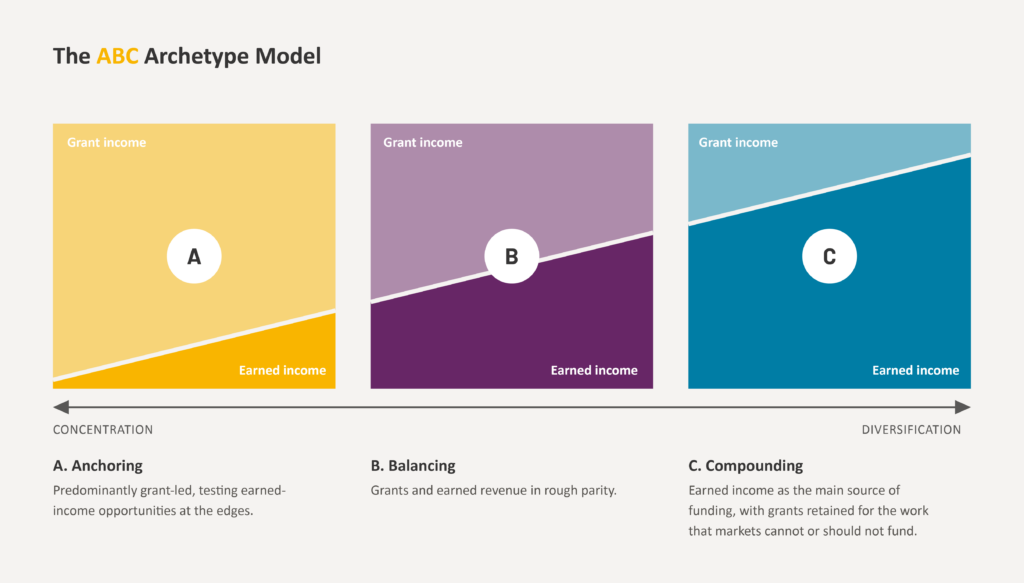
Crucially, the model is not a ladder. No archetype is inherently better or more suited to impact than another. The archetypes simply map inflection points on a journey, and levels of diversification remain fluid in practice.
Diversifying to build resilience
Diversification is not only about adding revenue streams. It also involves smarter cost structures, monetising technical capacity, and sharing financial responsibility differently between organisations, communities and partners. Grant capital frequently plays a transitional role, underwriting new activities until earned income can carry them.
For Talk To Your Midwife, a Ghanaian organisation transforming maternal and reproductive health services, the two logics work together:
“We generate revenue to be able to maintain what we are doing, and grant funding helps us to subsidise the prices.”
Innovation, in turn, tends to build on existing capabilities rather than pursue growth for its own sake. New products and services help organisations reach new users and cross-subsidise core work.
Aflatoun, an education organisation working globally on children’s social and financial education, channels commercial income from its venture arm back into its mission: “We basically charge them commercial rates and the profit of that will then go back into the NGO.” The research frames this shift most sharply where innovation and mission become inseparable.
It describes Rising Academies, a Sierra Leone education organisation working across East and West Africa, as treating innovation “as inseparable from mission delivery”, investing in curriculum, teacher coaching and digital tools that both improve learning outcomes and reach new users.
These gains come at a cost. As organisations layer new offerings onto existing models, operational load often rises faster than internal systems can adapt, demanding stronger financial management, new skills and, frequently, unrestricted funding to build the capacity that makes diversification sustainable. Timing matters as much as the choice itself: the same strategy can strengthen an organisation at one stage and destabilise it if pursued too early, before operational systems are ready, or too late, once financial pressure has already built up.
Holding mission and money together
As commercial and grant-based logics sit side by side, protecting purpose becomes an active discipline rather than a given. The organisations studied rely on explicit guardrails, ethical boundaries and leadership judgement to keep financial strategy in service of impact. For Safe Motherhood Alliance, the line is clear: “there is money we say no to.” Affordability is central to these trade-offs. Many organisations recognise that their core users cannot pay full commercial prices, which drives blended pricing, cross-subsidisation and partnership-based delivery. Affordability is treated less as a fixed decision than as an ongoing negotiation shaped by mission, learning and user realities.
Scaling is a collective effort
No organisation scales alone. Partnerships bridge gaps in financing, distribution, credibility and delivery, often by embedding solutions within existing systems rather than building parallel structures. Communities play an equally strategic role, acting as sources of trust, demand, cost-sharing and delivery capacity.
As Wonderbag puts it: “The greatest innovation comes out of communities.” Evidence ties it together. The ability to measure and verify impact increasingly determines access to new funding mechanisms, and data must be actively translated to meet the decision-making logic of multiple payers, from governments to institutional funders.
The full research explores each of these dynamics in depth, with concrete examples and organisational voices.