News
10 May 2026
Strategic corridors: connecting regions, transforming economies

The re-industrialisation of Europe and the industrialisation of Africa are closely linked: While Europe is seeking to strengthen its industrial and technological autonomy, Africa is entering a decisive phase in its industrial expansion, driven by demographic dynamism and the opportunity for a technological leap forward.
The African priority corridors are evidence of this linkage. By modernising transport routes and strengthening value chains, corridors facilitate trade and mobility within the African continent and with Europe. As part of the European Global Gateway investment plan, Enabel is playing an active role in 8 of the 12 priority corridors identified in Africa. The focus is on technical assistance, infrastructure, investment and ecological transition.
High-performance ports, decisive assets
Seaports play a major role in making this vision a reality. Port efficiency has a direct impact on the performance of the corridors: transport costs, local competitiveness and economic partnerships.
In West Africa, the Cotonou-Niamey Corridor links the landlocked countries of the Sahel to regional markets. In partnership with the Port of Antwerp-Bruges, Enabel is drawing on its expertise in port governance to support the modernisation of the Port of Cotonou in Benin – in particular, its competitiveness (the flow of goods has increased by 45% between 2010 and 2019) and its role as a gateway to Niger, Burkina Faso and northern Nigeria.
Enabel is also supporting the management and security of the Benin Corridor via support to the Republican Police in intervention patrolling in sensitive areas in the north and centre of the country.
At the other side of the continent, the focus is on the Dar es Salaam-Kigoma Corridor. In Tanzania, where the port of Dar es Salaam handles 95% of the country’s international trade, Enabel coordinates technical assistance for the corridor: While the Port of Antwerp-Bruges and TradeMark Africa are supporting the improvement of the Port’s operational performance and the harmonisation of customs processes, Enabel and UN Habitat are supporting the transition to a low-carbon economy.
Enabel is supporting the Tanzanian authorities in structuring the electric vehicle sector and charging infrastructure in collaboration with TAEMA (Tanzania Electric Mobility Association, the national association that represents actors in electric mobility). It is also working with the University of Dar es Salaam to adapt training courses to the green professions of tomorrow.
Levers for regional investment
The Abidjan-Lagos and Abidjan-Ouagadougou Corridors combine the movement of goods and people and economic development in West Africa.
“Enabel is supporting the sustainable management of corridors and ports, and promoting productive investment: the aim is to transform the corridors into a structured economic area by improving their ability to attract investors,” explains Jean-Christophe Charlier, Head of the Governance unit at Enabel.
This dynamic was embodied in the EU-West Africa Business Forum held in Abidjan from 30 March to 1 April 2026. In line with the Global Gateway strategy, projects identified along the corridors were presented to public and private investors.
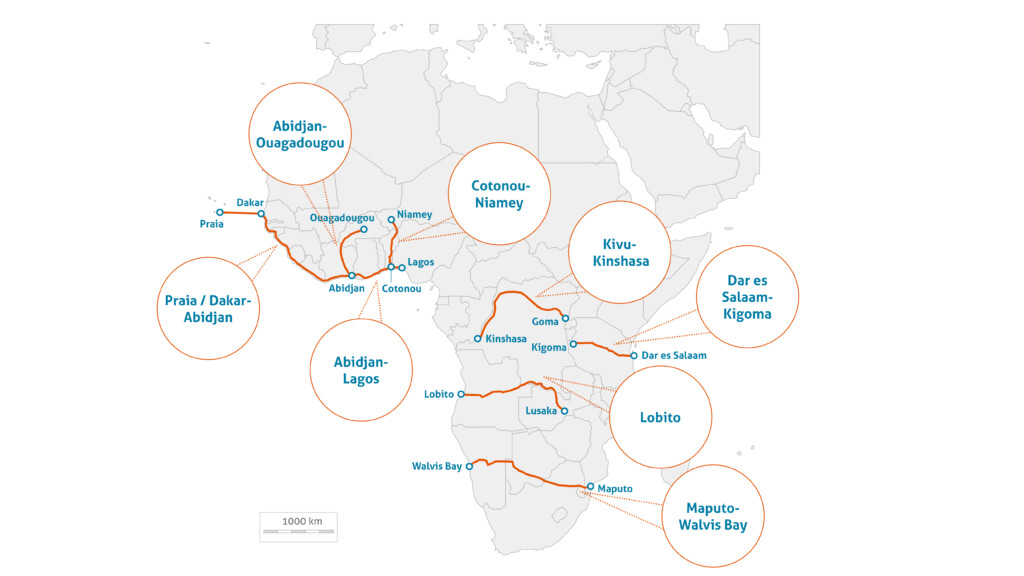
As for the Lobito Corridor, it links the mining regions of the Democratic Republic of Congo and Zambia (the Copperbelt) to the Port of Lobito in Angola on the Atlantic coast. By cutting rail freight transport from nearly a month to one week, it aims to boost regional trade, create jobs, and connect landlocked areas.
Through the Global Gateway, Enabel supports the Lobito Corridor Transit Transport Facilitation Agency, which is responsible for its trilateral management. As part of a Team Europe approach, Enabel also aims to support agro-food and mining value chains, financial governance in the mining sector and the training of young people in key trades along the corridors, like agro-industrial processing, rail transport services and energy. Support for the modernisation of the Port of Lobito, in partnership with the port of Antwerp-Bruges, is also being studied.
Through these initiatives, the corridors and their ports are becoming real engines of economic transformation and cooperation between Africa and Europe.
The Kivu-Kinshasa Green Corridor: engine of growth
In Africa, the Kivu-Kinshasa Green Corridor offers an alternative development path for the DR Congo. More than 2,600 km of roads and waterways link the Kivu provinces in the east of Congo to Kinshasa in the west. The area’s 540,000 km² Congo Basin forest, the second largest tropical forest in the world, needs to be protected. The Green Corridor is designed as an engine for inclusive green growth and aims to combine ecosystem conservation, socio-economic development and promotion of the green economy.
Enabel is supporting the development of agricultural supply chains: we help producers to organise themselves, improve food processing and facilitate transport from remote areas to economic centres. Enabel is also promoting river transportation along the Congo river. Finally, Enabel stimulates the development of the local private sector by supporting agro-entrepreneurship and responsible investment.
This initiative echoes the work of the Virunga Alliance, led by Emmanuel de Merode around the Virunga National Park, where an exceptional ecosystem is preserved while creating sustainable economic opportunities for local communities.